HAIR TRANSPLANT SCARRING: FUE VS FUT AND HOW TO MINIMIZE VISIBLE SCARS
One of the biggest concerns for patients considering a hair transplant is scarring. Many UK patients researching hair restoration in Turkey or London ask the same question before booking their procedure: “Will people be able to see my scars?”
The truth is that every surgical procedure leaves some form of scar tissue. However, modern hair transplant techniques have evolved dramatically over the past decade. Today, with advanced Sapphire FUE and DHI methods, visible scarring can often be minimized to the point where it becomes almost impossible to detect — even with short hairstyles.
DOES FUE LEAVE SCARS?
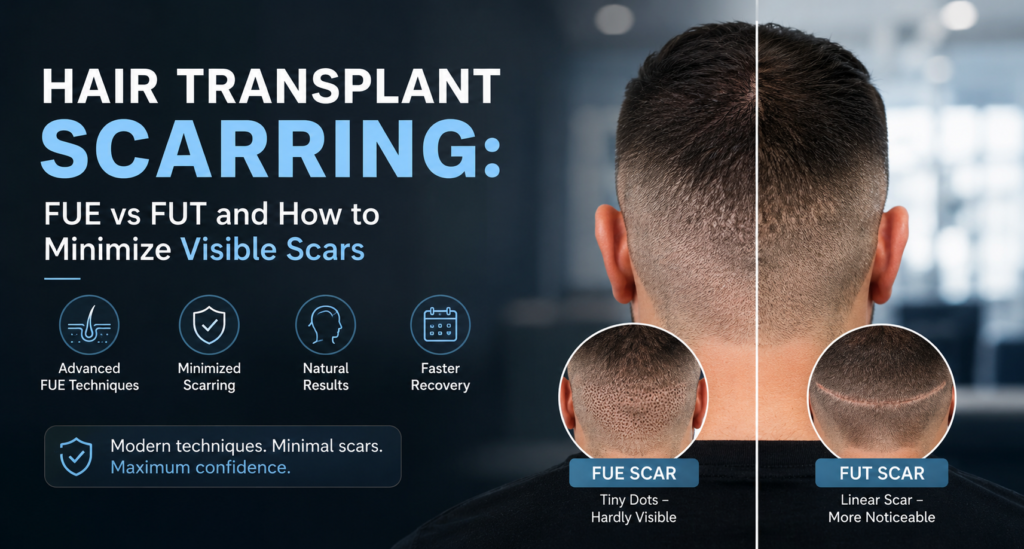
Yes, FUE hair transplant procedures do leave tiny scars, but they are micro-scars rather than a large linear scar. During Follicular Unit Extraction (FUE), individual grafts are removed one by one from the donor area using specialized micro punches.
When performed correctly by an experienced team, these extraction points heal as tiny dot-like marks that blend naturally into the surrounding hair. Most patients can comfortably wear short back-and-sides haircuts after healing.
The key factor is donor management. Overharvesting the donor area can create patchiness and visible thinning. This is why natural graft distribution and strategic extraction planning are critical.
FUT SCARS VS FUE SCARS
Unlike FUE, FUT (Follicular Unit Transplantation) involves removing a strip of skin from the donor area. This technique leaves a linear scar across the back of the scalp.
Although FUT can still be effective for certain patients, many modern clinics and international patients now prefer FUE because of:
- Faster recovery
- Less visible scarring
- Greater hairstyle flexibility
- Reduced discomfort
- More natural healing
For UK patients who frequently wear fades or shorter hairstyles, FUE is generally considered the more aesthetic option.
CAN HAIR TRANSPLANT SCARS BE REPAIRED?
Yes. Patients who previously had poor hair transplant experiences or visible donor scars may still be suitable for corrective procedures.
Some of the most effective scar repair solutions include:
- Scar camouflage with FUE graft implantation
- SMP (Scalp Micropigmentation)
- Beard donor graft extraction
- Hybrid repair techniques
- Scar revision procedures
In many cases, even older FUT scars can be softened and hidden successfully with modern corrective hair restoration methods.
HOW TO REDUCE VISIBLE SCARRING
Several factors influence how visible a hair transplant scar becomes:
- Surgeon experience
- Punch size used during extraction
- Skin type
- Healing quality
- Smoking and alcohol use
- Post-operative care
- Donor area planning
Following proper aftercare instructions is essential during the first 14 days after surgery. Patients should avoid scratching, excessive sun exposure, intense exercise, and smoking during the healing period.
FAQ – HAIR TRANSPLANT SCARRING
1. Does a hair transplant leave permanent scars?
Yes, every hair transplant procedure creates some level of scarring. However, modern Sapphire FUE techniques create tiny micro scars that are usually difficult to notice after healing, especially when surrounded by existing hair.
2. Which hair transplant technique leaves the least visible scars?
FUE and Sapphire FUE procedures generally leave less visible scarring compared to FUT (strip method). FUT may create a linear scar on the back of the scalp, while FUE creates small dot-shaped scars.
3. Can hair transplant scars be hidden?
Yes. Most FUE scars are naturally hidden within the donor area hair. Patients who keep their hair extremely short may notice tiny extraction points, but they are usually minimal.
4. How long does hair transplant scar healing take?
Initial healing usually takes around 10–14 days. Redness can improve within several weeks, while complete scar maturation may continue for several months.
5. Can poor hair transplant techniques cause visible scarring?
Yes. Overharvesting, incorrect punch sizes, inexperienced extraction methods, or poor donor management can lead to visible scarring and donor area damage.
6. Does Sapphire FUE reduce scarring?
Sapphire FUE is designed to minimize trauma to the scalp by using advanced sapphire blades and precise graft extraction methods, helping improve healing and reduce visible scars.
7. Can hair grow through hair transplant scars?
In many cases, yes. Corrective hair transplant procedures can often implant grafts into scar tissue to improve appearance and coverage depending on blood circulation and scar condition.
8. What increases the risk of visible hair transplant scars?
Smoking, poor aftercare, sun exposure, infection, aggressive extraction, and individual skin healing characteristics can increase scar visibility after surgery.
9. Can donor area scars be corrected?
Yes. Treatments such as corrective FUE procedures, scalp micropigmentation (SMP), PRP therapy, and scar revision techniques may improve the appearance of donor scars.
10. How can I reduce hair transplant scarring after surgery?
Following proper aftercare instructions, avoiding smoking, protecting the scalp from direct sunlight, avoiding heavy exercise during recovery, and attending follow-up appointments can help minimize visible scarring.
FINAL THOUGHTS
Modern hair transplantation is no longer about simply moving hair follicles. It is about achieving natural density while preserving the donor area for the future.
For patients considering a hair transplant in Turkey or London, understanding scarring is just as important as understanding graft numbers or pricing. Choosing an experienced clinic with ethical donor management and advanced FUE techniques can make the difference between an obvious procedure and a completely natural-looking result.