FUE VS DHI HAIR TRANSPLANT: WHICH TECHNIQUE IS RIGHT FOR YOU?
If you have been researching hair transplant options in London or Turkey, you have almost certainly come across two terms that dominate the conversation: FUE and DHI. Both are advanced, modern, minimally invasive techniques. Both deliver natural-looking, permanent results. But they are not the same, and understanding the difference can be the deciding factor between a hair transplant that meets your expectations and one that falls short. This guide breaks down FUE versus DHI in plain English, comparing density, scarring, recovery, cost and ideal candidates so you can make an informed decision before your consultation.
THE TWO LEADING TECHNIQUES IN MODERN HAIR RESTORATION
Hair transplant surgery has evolved dramatically over the past two decades. The old strip method, known as FUT, has largely been replaced by two refined techniques that extract individual hair follicles one by one and reposition them where they are needed most. Follicular Unit Extraction, or FUE, has been the gold standard since the early 2000s. Direct Hair Implantation, or DHI, is a more recent refinement that changes how follicles are placed into the scalp. Both procedures are performed at our London clinic and at our partner hospitals in Istanbul, Antalya and Bodrum.
WHAT IS FUE HAIR TRANSPLANT?
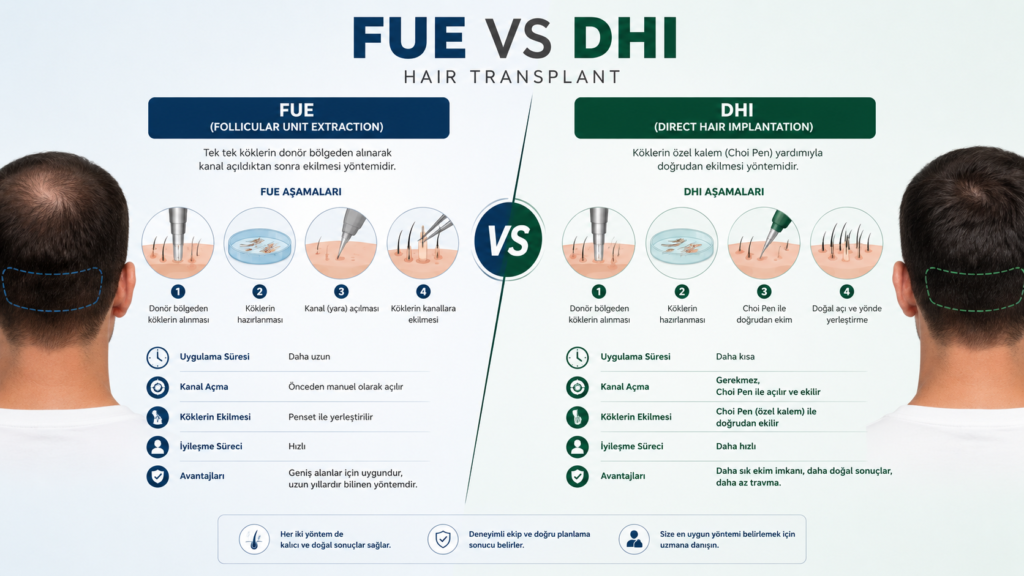
FUE stands for Follicular Unit Extraction. The procedure involves extracting individual hair follicles from a donor area, usually the back or sides of the scalp where hair is genetically resistant to thinning. A specialist uses an ultra-fine micro punch tool, typically less than one millimetre in diameter, to remove each follicular unit one at a time. Once extracted, the follicles are stored in a preservation solution while the surgeon creates tiny incision channels in the recipient area. The follicles are then placed one by one into these prepared channels using forceps. FUE is precise, minimally invasive and leaves only microscopic dot scars that are virtually undetectable, even with short haircuts.
WHAT IS DHI HAIR TRANSPLANT?
DHI stands for Direct Hair Implantation. It is a refinement of the FUE technique rather than a completely different procedure. The extraction phase is identical to FUE. The difference lies in the implantation step. Instead of creating channels first and then placing follicles, DHI uses a specialised instrument called a Choi pen. The Choi pen is loaded with a single follicle and used to make the incision and implant the hair in one combined motion. This eliminates the gap between extraction and implantation, reducing the time follicles spend outside the scalp. DHI requires more technical skill, more time per session and more pens per procedure, which is reflected in the price.
KEY DIFFERENCES BETWEEN FUE AND DHI
The headline difference between FUE and DHI is the implantation method, but several other practical differences affect your experience as a patient. With FUE, the surgeon shaves the entire donor area and often the recipient area as well. With DHI, only the donor area needs to be shaved, which is a significant advantage for women and for men who prefer not to fully shave their head before the procedure. FUE typically takes six to eight hours for a large session. DHI can take eight to ten hours because of the additional precision required with the Choi pen. FUE allows the surgeon to transplant up to four thousand grafts in a single session. DHI is generally limited to two thousand five hundred to three thousand grafts per session because of the time required.
DENSITY AND HAIRLINE DESIGN
One of the most important questions patients ask is which technique delivers better density. The honest answer is that both can deliver excellent density when performed by experienced surgeons, but DHI has a slight edge in two specific scenarios. The Choi pen allows for more precise control over the angle, direction and depth of each follicle. This makes DHI particularly suitable for hairline design, where the front-most rows of hair must follow a very specific curve and direction to look natural. DHI can also achieve slightly higher density per square centimetre because of the precision of placement. FUE remains excellent for full-head transplants and for patients with extensive coverage needs, where the slightly faster pace makes the procedure more comfortable.
SCARRING COMPARISON
Both FUE and DHI are minimally invasive and leave only microscopic dot scars in the donor area. There is no linear scar like the old FUT strip method. In practice, the scarring difference between FUE and DHI is negligible for most patients. Both techniques allow you to wear short haircuts, including a number two clipper, without visible scarring once healing is complete. If you are particularly concerned about scarring, choose a surgeon who uses sapphire blades for the channel creation step in FUE, which produces even smaller incisions and faster healing.
RECOVERY TIMELINE COMPARISON
Recovery times for FUE and DHI are nearly identical because the biological healing process is the same. You can expect mild redness and tiny scabs for seven to ten days, a shedding phase between weeks two and four, early regrowth between months three and five, and final results at twelve months. The only meaningful difference during recovery is that DHI patients do not need to fully shave the recipient area, which makes the immediate post-operative appearance less dramatic. Many UK patients prefer this for return-to-work reasons, particularly those in client-facing roles. Both techniques allow you to return to office work within seven to ten days, and both require the same aftercare protocol including no swimming, sauna or intense exercise for the first three weeks.
WHICH TECHNIQUE COSTS MORE?
DHI is consistently more expensive than FUE, both in the UK and in Turkey. In London, a typical FUE procedure starts at around three thousand pounds for smaller sessions and rises to seven thousand pounds or more for full-head transplants. DHI in London typically adds twenty to forty percent to the FUE price. In Turkey, the price difference between FUE and DHI is also significant, although the absolute prices are substantially lower across the board. For UK patients comparing options, this means a DHI procedure in Turkey often costs less than a basic FUE procedure in London while delivering equal or better results. Our complete cost comparison for three thousand graft procedures is available in our blog archive.
WHO IS A BETTER CANDIDATE FOR FUE?
FUE remains the right choice for patients who need large sessions, typically three thousand grafts or more, because of its faster pace. It is also ideal for patients with extensive baldness who require full coverage of the crown and mid-scalp, where precise hairline design is less critical than overall density. FUE is the better-value option for budget-conscious patients who still want premium results. Men with significant hair loss across multiple zones of the scalp generally benefit most from FUE because of the larger graft counts achievable in a single session.
WHO IS A BETTER CANDIDATE FOR DHI?
DHI is the optimal choice for patients who prioritise hairline precision, including patients getting their first few rows redesigned after previous unsatisfactory transplants. It is also the technique of choice for female patients, because the recipient area does not need to be shaved, allowing women to retain their existing hair length during the procedure. Patients seeking maximum density in a smaller area, such as the temples or a receded hairline, benefit from DHI. Professionals who need to return to public-facing work quickly after the procedure often prefer DHI for the same shave-free reason. Eyebrow and beard transplants are almost always performed using the DHI technique.
THE HYBRID APPROACH: BEST OF BOTH WORLDS
For many patients, the answer is not FUE or DHI but a combination of both. Our Hybrid Hair Transplant procedure uses DHI for the hairline and frontal zone where precision matters most, and FUE for the crown and mid-scalp where larger graft volumes are needed. This combination delivers the natural hairline design of DHI with the density coverage of FUE, all in a single session. The hybrid approach has become increasingly popular among our UK patients who travel to our Istanbul clinic, and we cover the full procedure in our dedicated Hybrid Hair Transplant Turkey blog post.
CHOOSING THE RIGHT CLINIC IN LONDON OR TURKEY
The technique matters, but the surgeon matters more. A skilled FUE surgeon will deliver better results than an inexperienced DHI specialist, regardless of which tools are used. When comparing clinics, ask three questions. First, how many procedures has the lead surgeon personally performed? Second, will the surgeon perform the extraction and design phases personally, or will technicians do most of the work? Third, can you see verified before-and-after photographs of patients with hair loss patterns similar to yours? Our Chelsea London clinic offers in-person consultations for UK patients, with the option to either proceed with treatment in London or travel to our partner hospital in Istanbul for the full procedure at lower cost.
FINAL VERDICT: WHICH TECHNIQUE IS RIGHT FOR YOU?
There is no universally better technique. FUE is the right choice if you need large coverage, want the most cost-effective premium option or are getting your crown restored. DHI is the right choice if hairline precision is your priority, you want to skip shaving the recipient area or you are a female patient. For most patients with both hairline and crown concerns, a hybrid procedure combining FUE and DHI delivers the strongest result. The only way to know for certain which option suits your specific hair loss pattern, donor density and aesthetic goals is a proper consultation with a qualified surgeon.
Ready to find out which technique is right for you? Book a free consultation at our Chelsea London clinic or contact our Istanbul team via WhatsApp at plus four four seven four three seven nine two zero eight one one. We will assess your donor area, discuss your goals and recommend the technique that delivers the best result for your case.