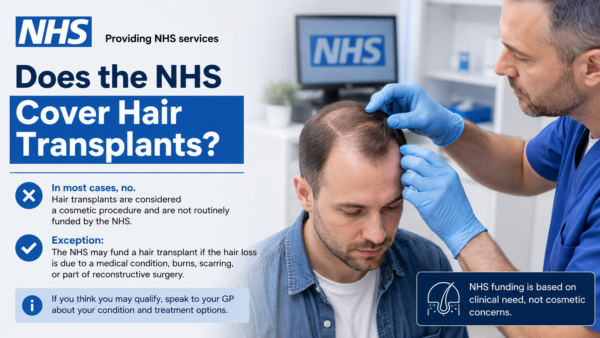
Does the NHS Cover Hair Transplants? What UK Patients Need to Know in 2026
If you are losing your hair and wondering whether the NHS will foot the bill for a hair transplant, you are not alone. It is one of the most searched questions among British men and women researching hair restoration — and the answer, while straightforward, opens up a conversation that most NHS-focused articles deliberately avoid. This guide gives you the full picture: what the NHS will and will not do, what private UK clinics charge, and why tens of thousands of British patients are now choosing a different path entirely.
DOES THE NHS COVER HAIR TRANSPLANTS?
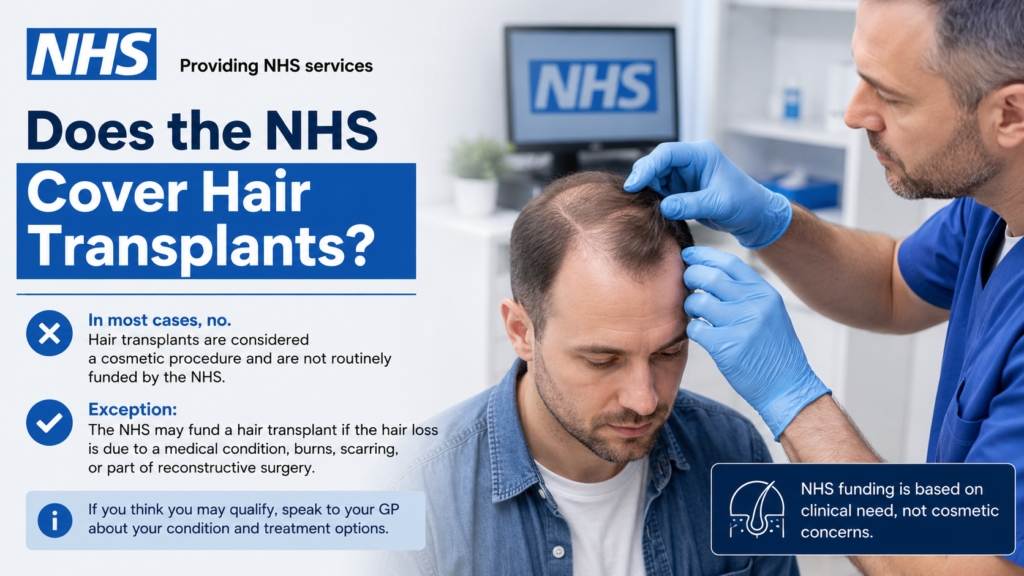
In almost all cases, no. The NHS does not fund hair transplant surgery for cosmetic reasons, and hair loss — whether caused by male pattern baldness, female androgenetic alopecia, or general thinning — is classified as a cosmetic condition in the vast majority of circumstances.
NHS funding for hair restoration is reserved for a narrow set of medical exceptions. These include hair loss resulting from burns or traumatic scarring, certain autoimmune conditions such as severe alopecia areata where the hair loss significantly impacts mental health and other treatments have failed, and hair loss directly caused by cancer treatment in specific cases where reconstructive intervention is considered medically necessary rather than cosmetic.
Even within these exceptions, NHS funding is subject to Clinical Commissioning Group decisions that vary by region. What qualifies for funding in one NHS trust may be declined in another. The waiting lists for any considered treatment are long, the criteria are strict, and the outcome is uncertain. For the overwhelming majority of people reading this article — those experiencing typical hair loss who want their hairline restored — NHS funding is not a realistic option.
WHAT CAN THE NHS ACTUALLY DO FOR HAIR LOSS?
While hair transplant surgery is off the table, the NHS does offer limited non-surgical interventions for certain types of hair loss. Your GP can prescribe Finasteride for male pattern baldness, which is available at standard prescription cost and can slow or halt further loss in many patients. Minoxidil in its standard form is available over the counter without prescription. For alopecia areata, the NHS may offer steroid injections, topical immunotherapy, or in some cases JAK inhibitor medications following specialist referral.
These treatments address the progression of hair loss. They do not restore hair that has already been lost. They do not rebuild a hairline. They do not fill in a thinning crown. For patients who want actual hair restoration rather than loss prevention, NHS pathways reach their limit very quickly — and the waiting time to even access a dermatology referral through a GP can run to months.
The NHS is one of the world’s great public health institutions. Hair transplant surgery is simply not what it is designed or funded to deliver for cosmetic conditions, and no amount of persistence with a GP referral will change that reality for most patients.
WHAT DOES A PRIVATE HAIR TRANSPLANT COST IN THE UK?
If NHS funding is not available and you are considering staying in the UK for your procedure, private hair transplant pricing is the next question. The honest answer is that private UK hair transplant costs are among the highest in the world.
A FUE hair transplant at a reputable UK private clinic typically costs between £5,000 and £15,000 depending on the number of grafts required, the clinic’s location, and the seniority of the surgeon. London clinics at the premium end of the market charge between £8 and £12 per graft, meaning a procedure requiring 3,000 grafts — a moderate case of hair loss — will cost between £24,000 and £36,000 at per-graft pricing, though most clinics offer package pricing that brings this down significantly.
Even at the more accessible end of the UK market, a 2,000 to 3,000 graft FUE procedure will typically cost between £5,000 and £9,000. DHI procedures, which require additional specialised equipment and longer surgical time, command a premium above these figures. Sapphire FUE sits between standard FUE and DHI in most UK clinic pricing structures.
These prices reflect the genuine cost of delivering surgical procedures in the UK: surgeon fees, CQC-regulated clinic overheads, nursing staff, anaesthetist costs, and the premium associated with London and major city locations. UK private hair transplant clinics are not overcharging by global standards — they are simply operating in one of the world’s most expensive healthcare markets.
WHY UK PATIENTS ARE CHOOSING TURKEY INSTEAD

Here is where the conversation shifts — and where the numbers become very difficult to ignore. The same FUE procedure that costs £7,000 to £12,000 at a reputable UK private clinic costs between £1,490 and £2,500 at a leading Turkish clinic, including accommodation, airport transfers, and full aftercare. The surgical technique is the same. The graft extraction methodology is the same. The aftercare protocol is the same. The result, when you choose the right clinic, is the same.
Turkey performs more hair transplants annually than any other country in the world. The concentration of experienced surgeons, the scale of the industry, and the decades of accumulated clinical expertise mean that the leading Turkish clinics are not offering a budget compromise — they are offering a genuinely world-class procedure at a fraction of UK pricing because the cost of delivering healthcare in Turkey is structurally lower, not because corners are being cut.
Micro FUE Turkey, with consultation offices at 204 Fulham Road in Chelsea and at The Clock House in Purley, operates clinics in both Istanbul and Antalya. British patients can meet with the team in London before committing to anything, review their case with the lead surgeon via video consultation, and travel to Turkey knowing exactly what procedure they are having, who will perform it, and what results to expect. The London consultation is not a sales appointment. It is a clinical assessment — the same assessment that would precede any private procedure in the UK, conducted by the same medical team that will carry out your surgery.
THE REAL COST COMPARISON: NHS WAITING + UK PRIVATE VS TURKEY
Consider the practical journey for a British man in his thirties experiencing Norwood 3 to 4 hair loss. He visits his GP. The GP confirms the diagnosis, offers a Finasteride prescription, and explains that cosmetic hair restoration is not an NHS-covered procedure. He researches private UK clinics and receives quotes ranging from £6,500 to £11,000. He researches Turkey and finds all-inclusive packages starting from £1,490 with direct flights from London Gatwick or Heathrow to Istanbul or Antalya available from £80 to £150 each way.
The total Turkey trip cost — procedure, flights, three nights of accommodation, transfers — comes to approximately £2,000 to £2,800 for a complete all-inclusive experience. Against a UK private quote of £6,500 to £11,000, the saving is between £4,500 and £8,200 on a procedure delivered to the same clinical standard by surgeons with equivalent or greater hair transplant specific experience.
That saving is not marginal. It is transformative. It represents the difference between hair restoration being accessible or being out of reach entirely for a large proportion of British patients.
WHAT ABOUT SAFETY AND AFTERCARE?
The most common concern among British patients considering Turkey is safety — and it is a legitimate concern, not because Turkey is inherently unsafe, but because the market contains both excellent clinics and genuinely poor ones, and distinguishing between them requires informed research.
Reputable Turkish hair transplant clinics operate under Ministry of Health licensing, maintain JCI accreditation standards, employ board-certified surgeons with documented procedural track records, and use the same surgical equipment and graft implantation tools as leading European clinics. The risks associated with FUE surgery — infection, poor graft survival, unnatural hairline design — are not unique to Turkey. They are the risks of choosing the wrong clinic anywhere in the world.
The advantage of working with Micro FUE Turkey through the London consultation model is that UK patients are not navigating this independently. The London team handles the clinical assessment, confirms candidacy, sets expectations for graft count and hairline design, and maintains direct communication throughout the twelve-month growth cycle after surgery. Patients returning to the UK have access to PRP aftercare sessions at The Clock House in Purley and at the Chelsea location, meaning the post-operative support continues on UK soil with the same medical team rather than ending the moment you board your return flight.
YOUR NEXT STEP: LONDON CONSULTATION, ZERO OBLIGATION
If you have been waiting for the NHS to fund a hair transplant that will never arrive, or pricing up UK private options that feel financially out of reach, the Micro FUE London consultation is designed precisely for your situation. There is no charge. There is no obligation to proceed. You will leave with a clear clinical picture of your hair loss pattern, an honest assessment of what a transplant can achieve in your case, a graft count estimate, and a fully itemised package cost for Istanbul or Antalya.
Book your free consultation at our Chelsea clinic on Fulham Road SW10 or at The Clock House in Purley CR8 via WhatsApp on +447437920811. You can also submit your photos for a remote pre-assessment before your in-person visit.
The NHS cannot help you restore what you have lost. UK private clinics can — at a price that many patients find prohibitive. Micro FUE Turkey, assessed and booked through our London offices, offers the third option: world-class hair restoration at a price that makes it genuinely accessible for British patients in 2026.